

Liquid Web has been operating since 1997. It focuses on infrastructure for businesses, agencies, developers, and high-traffic sites. Its range centers on cloud VPS, managed VPS, dedicated servers, managed WordPress, and WooCommerce rather than the cheap shared-hosting bundles sold by mainstream hosts. That specialization gives it more depth than most providers, but also makes plan selection and pricing more complicated.
- Interested in Liquid Web? Check out the website here
Liquid Web: Plans and pricing
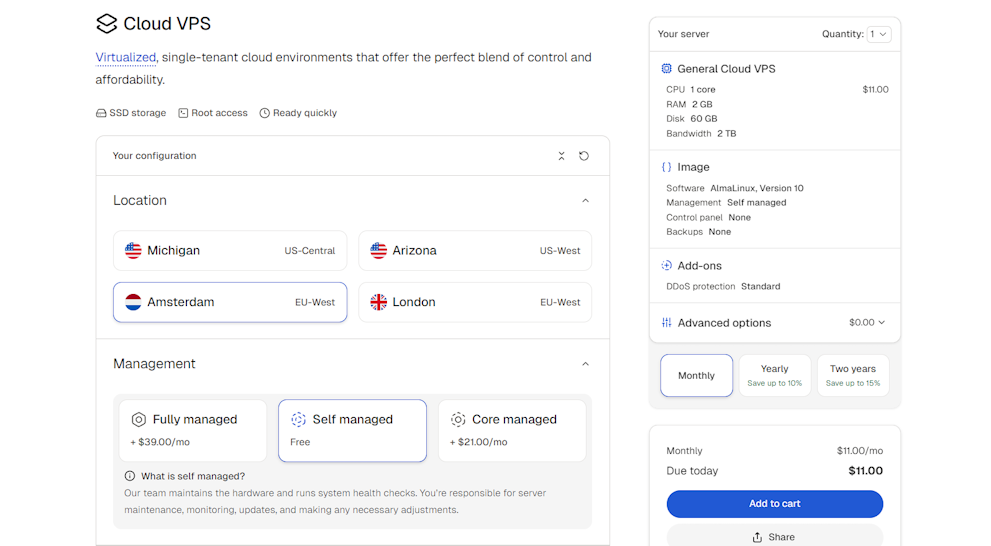
The entry Cloud VPS configuration quoted by Liquid Web's sales team uses one CPU core, 2GB of RAM, 60GB of SSD storage, and 2TB of bandwidth for $11 a month.
It is self-managed, with no control panel or backups, and the Amsterdam location costs the same as the US option. That is a reasonable raw-server price, but customers are responsible for the operating system, security, updates, and applications.
Pricing requires care. Liquid Web's public VPS page was still advertising a $5 1GB plan when I checked, but a sales agent said that plan was no longer available and directed me to the current $11 configuration.
A separate promotion reduced a 4GB, two-vCPU server from $17 to $8.50 for its first two months. The discounts are clearly labeled once found, but the mismatch between the landing page and the live sales information is unnecessarily confusing.
The low base price changes dramatically when Liquid Web's signature services are added. Sales confirmed that the 2GB server with full management and cPanel Admin Cloud 5 costs $86 a month in total. The least expensive Acronis option adds another $22 for 100GB, bringing that setup to $108 a month. Its default retention is seven daily, four weekly, and one monthly backup, and the schedule can be adjusted. Liquid Web's public managed VPS range starts at $72 a month for two vCPUs, 4GB of RAM, 80GB of SSD storage, and 3TB of bandwidth, before any separately priced options.
Managed WordPress is much cheaper. Spark Launch starts at $5 a month when billed annually and supports one site, 15GB of storage, and 2TB of bandwidth, with unlimited visits, daily backups retained for seven days, staging, Cloudflare Enterprise, DDoS protection, and a web application firewall. This is the more approachable choice for one WordPress site; VPS makes sense when the workload or need for server-level control justifies the extra complexity.
There is no free Cloud VPS trial, and sales confirmed that monthly Cloud VPS purchases are generally non-refundable. That is a material disadvantage when the useful managed configurations cost far more than their headline server price. Customers should finalize the location, management tier, panel, and backup requirements before ordering.
Liquid Web: Ease of use
Liquid Web's configurator provides unusually granular choices. Depending on the product, customers can select the server size, data center, operating system, self-managed, core managed, or fully managed support, and a control panel such as InterWorx, Plesk, or cPanel. Self-managed customers retain root access and handle administration themselves. Fully managed support adds operating system and control panel updates, security patches, monitoring, server-side troubleshooting, firewall configuration, and help with common software.
There is no demo account for exploring the customer portal before purchase. Even so, our hands-on VPS testing found the management interface clear and intuitive. Installing WordPress was straightforward, the AI site-building tool made it easy to create a starting point, and importing a prepared WordPress and WooCommerce site worked without the credential and database confusion encountered with InMotion Hosting.
Liquid Web also offers a dedicated migration team. On managed services, it can move website content, email, databases, and control panel accounts while coordinating the process to minimize downtime. That hands-on assistance is one reason to pay for management, particularly for agencies or businesses moving a revenue-generating site. Domain registration is not bundled with the server, and Liquid Web is not the natural choice for someone who wants a domain, email, site builder, and hosting in one inexpensive package.
Liquid Web: Speed and experience
Performance is where Liquid Web makes its strongest case. In our WordPress server benchmark, which measures CPU, memory, file operations, database performance, and network speed, Liquid Web produced an overall server score of 8.1 compared with InMotion Hosting's 6.1.
It scored 10 for small-file I/O, 9.66 for local file copying and access, 9.72 for simple database queries, 9.64 for complex database queries, and 9.53 in the network download test. Those are excellent results for a business-focused VPS and support its position as our best VPS host overall.
Our broader testing has been similarly positive. Liquid Web's main website earned an A and 100% performance score in GTmetrix, although its 6.8-second full load time showed why a single headline grade should not be read in isolation.
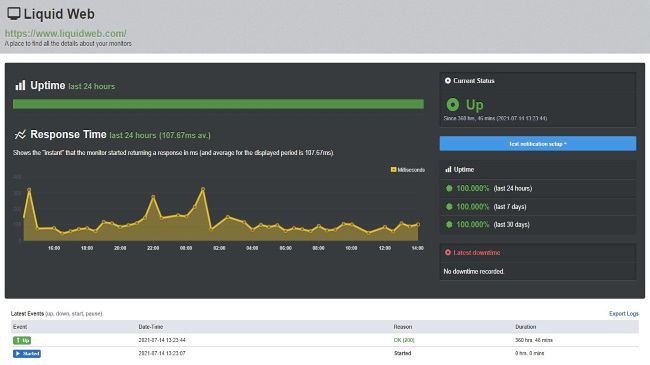
In a separate two-week UptimeRobot test of the same public site, we recorded no downtime and an average response time of around 107ms. These tests measure different aspects of performance, but both point to a fast and dependable platform.
Liquid Web backs its infrastructure with a 100% network uptime SLA. The wording matters: it guarantees that major routing devices in its network remain reachable from the global internet, rather than promising that every application will run without interruption. Even with that distinction, the guarantee is stronger than the 99.9% or 99.99% figures common among general-purpose hosts.
Liquid Web: Support
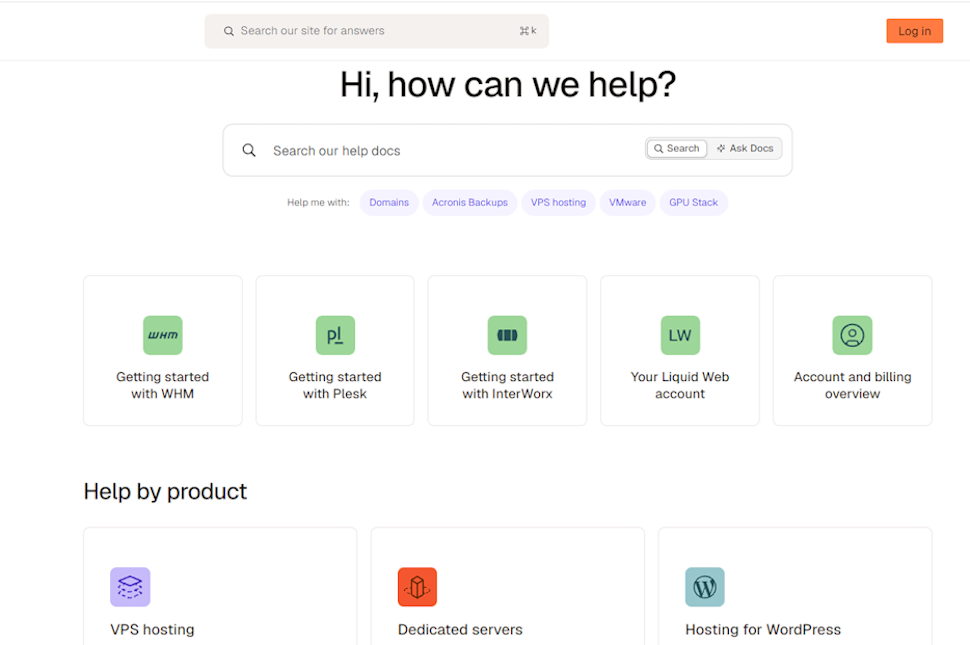
Support is available 24/7/365, with the scope depending on the chosen management tier. Self-managed customers receive network and hardware support, while core managed and fully managed plans progressively add operating system maintenance, monitoring, troubleshooting, panel support, and software assistance. The documentation is extensive, and customers can use live chat or open a support case from the portal.
My pre-sales check produced a human acknowledgment in 20 seconds, comfortably inside Liquid Web's advertised 59-second initial response target. The first substantive answer arrived after about four minutes. The agent clearly confirmed that the old $5 plan was unavailable, that Amsterdam carried no location surcharge, and that the $11 server included neither management, a control panel, nor backups.
After correcting a price typo, the agent confirmed the $86 total for the 2GB VPS with full management and cPanel, the $22 Acronis option, its retention schedule, and the lack of a standard refund. The answers were detailed rather than evasive, and the agent supplied configuration and policy links.
Sales also confirmed that Liquid Web still promotes a 59-second response target, although its current SLA describes initial chat and help-desk response times as goals rather than guarantees. I liked the directness of the exchange, even if the four-minute wait for a full answer shows that a fast initial response is not the same as an immediate resolution.
Liquid Web: The competition
ScalaHosting is the more approachable managed VPS alternative. Its SPanel ecosystem bundles many hosting-management tasks into a lower-cost package and suits users who want to avoid cPanel licensing fees.
In our direct WordPress benchmark comparison, ScalaHosting scored 8.3 against Liquid Web's 8.1, so performance was closely matched rather than a clear Liquid Web victory. Liquid Web offers deeper infrastructure choices and a broader high-end range, but the price difference becomes substantial once equivalent management, panel, and backup options are selected.
Cloudways takes a different approach by managing servers from infrastructure providers such as DigitalOcean, Vultr, AWS, and Google Cloud. It is easier to enter at a moderate monthly cost and is especially attractive for WordPress, but it does not offer cPanel and does not provide the same conventional managed-server relationship. Liquid Web is the stronger fit when infrastructure control, migration help, and an experienced server support team matter more than the lowest monthly bill.
Liquid Web: Final verdict
Liquid Web remains one of the best choices for businesses that need a serious VPS rather than a cheap hosting account. Its benchmark results are excellent, its server configurations are flexible, and its support team gives specific, technically useful answers. Those strengths justify its position as our best VPS host overall for demanding sites, agencies, and customers who value managed infrastructure.
It is not the best-value option for everyone. The $11 entry server is a bare self-managed configuration, the website still shows a discontinued $5 offer, Cloud VPS purchases are generally non-refundable, and a representative managed configuration can exceed $100 once cPanel and backups are included. Beginners with one modest WordPress site should consider the managed WordPress range or a conventional shared host instead.
Choose Liquid Web when performance, configuration freedom, migration assistance, and capable support are worth paying for. Choose ScalaHosting or Cloudways when easier entry pricing matters more. Liquid Web earns four stars because its premium experience is convincing, but its pricing needs to be read all the way through the configurator rather than judged by the headline figure.




