

Kanary remains one of the stronger data removal services going into 2026, particularly for US-based users who want ongoing monitoring and a mix of automated and guided removals rather than pure one‑off scans. It sits toward the upper end of the market in terms of price but compensates with broad broker coverage (300+ sites), clear progress tracking, and solid security practices, making it a credible choice alongside better-known names like DeleteMe and Incogni.
Data brokers, people‑search sites, and marketing databases continue to proliferate in 2026, quietly collecting and trading personal details such as names, home addresses, phone numbers, and dates of birth. Services like Kanary aim to claw that information back by scanning hundreds of data brokers, sending opt‑out requests, and monitoring for reappearances over time. Kanary focuses primarily on US‑based exposure and has built its service around a straightforward promise: reach 95–100% removal success after the first few months of active monitoring and cleanup for typical users.
Kanary is best suited to individuals, families, and smaller organizations that want an automated “set‑and‑forget” removal service with periodic rescan and a clear dashboard, and who are willing to pay a bit more for stronger coverage and privacy assurances. It does not bundle identity theft insurance or global coverage, so users looking for those extras may prefer competitors that combine data removal with broader protection suites.
Kanary: Plans and pricing
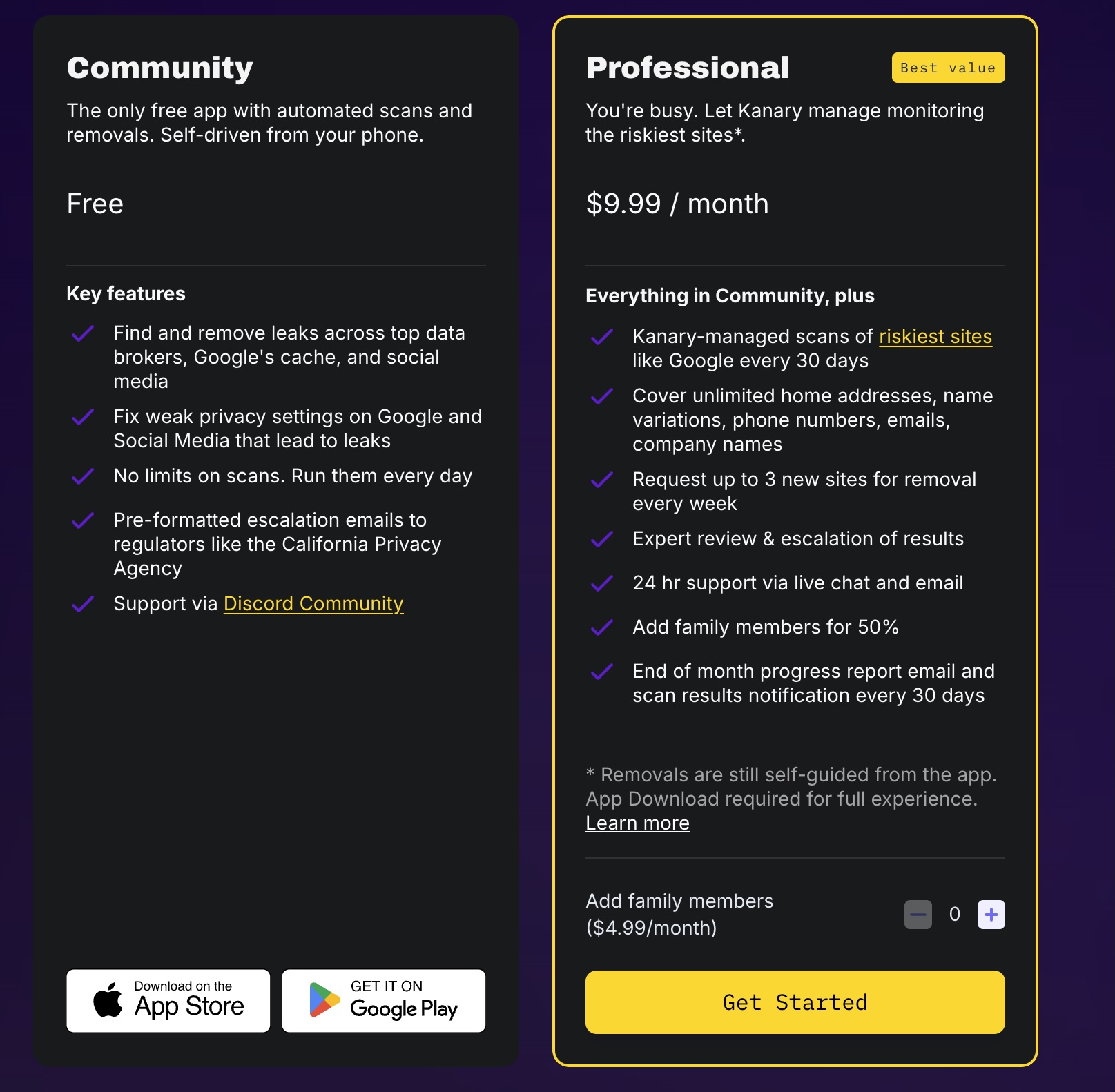
Kanary continues to offer a free option plus paid tiers, with pricing that puts it on the high side compared to some basic removal‑only tools but still below premium suites that bundle insurance or extensive international coverage. The long‑running 14‑day free trial remains a key hook: new users can test the platform with a handful of removals, and if they don’t upgrade, the account effectively falls back to a limited free tier that still provides some monitoring and DIY guidance.
The Premium individual subscription is still structured around monthly and annual billing: the month‑to‑month plan runs about $16.99, while the annual plan is billed at $179.88 per year (equivalent to $14.99 per month), keeping Kanary in line with other higher‑end data removal tools. The ability to add family members remains an important differentiator: additional users can be attached to an existing subscription for a monthly surcharge, which is slightly cheaper if you commit annually. For organizations, Kanary’s Enterprise (or Teams) offering is priced at around $179.88 per user per year, with volume handled through sales and designed to protect executives and high‑risk staff.
Compared with competitors, Kanary’s annual pricing is more expensive than budget‑oriented tools and some mid‑range services, but cheaper than certain high‑tier offerings like Privacy Bee, which can run close to $197 per year. This means you are paying a premium over bare‑bones removal services in exchange for broader broker coverage, a usable free tier, and better security and transparency than many low‑cost alternatives.
Kanary: Features

Kanary’s core value lies in its broker coverage and continuous monitoring, rather than flashy extras or bundled insurance. The service currently covers roughly 300–325 data brokers and related sites in the United States, spanning people‑search providers, marketing databases, health‑related brokers, and recruitment‑focused platforms. For a majority of these, Kanary can send automated opt‑out requests on your behalf; for the rest, it supplies templates and step‑by‑step guides so you can complete manual removals if desired.
Once your account is live, Kanary performs an initial exposure scan to find where your information is published and then begins batch opt‑outs across its supported broker list. Progress is displayed on a central dashboard that tracks completed removals, pending requests, and sites that require manual action or additional verification, giving you a clear sense of how your digital footprint shrinks over time. Kanary continues to rescan monthly, resurfacing old exposures and new listings so it can either re‑initiate removals or guide you through tougher cases, which is particularly useful as brokers repopulate data or new aggregators come online.
In addition to broker opt‑outs, Kanary’s service extends to major tech platforms and search engines, offering removal requests for exposed personal information in Google Search results and providing guidance on data on sites such as Facebook and other social networks. Users on higher‑end plans also gain access to a custom domain and email support, enabling Kanary to more efficiently authenticate requests and speed up removals when specific domains or addresses are repeatedly scraped.
Kanary: Setup
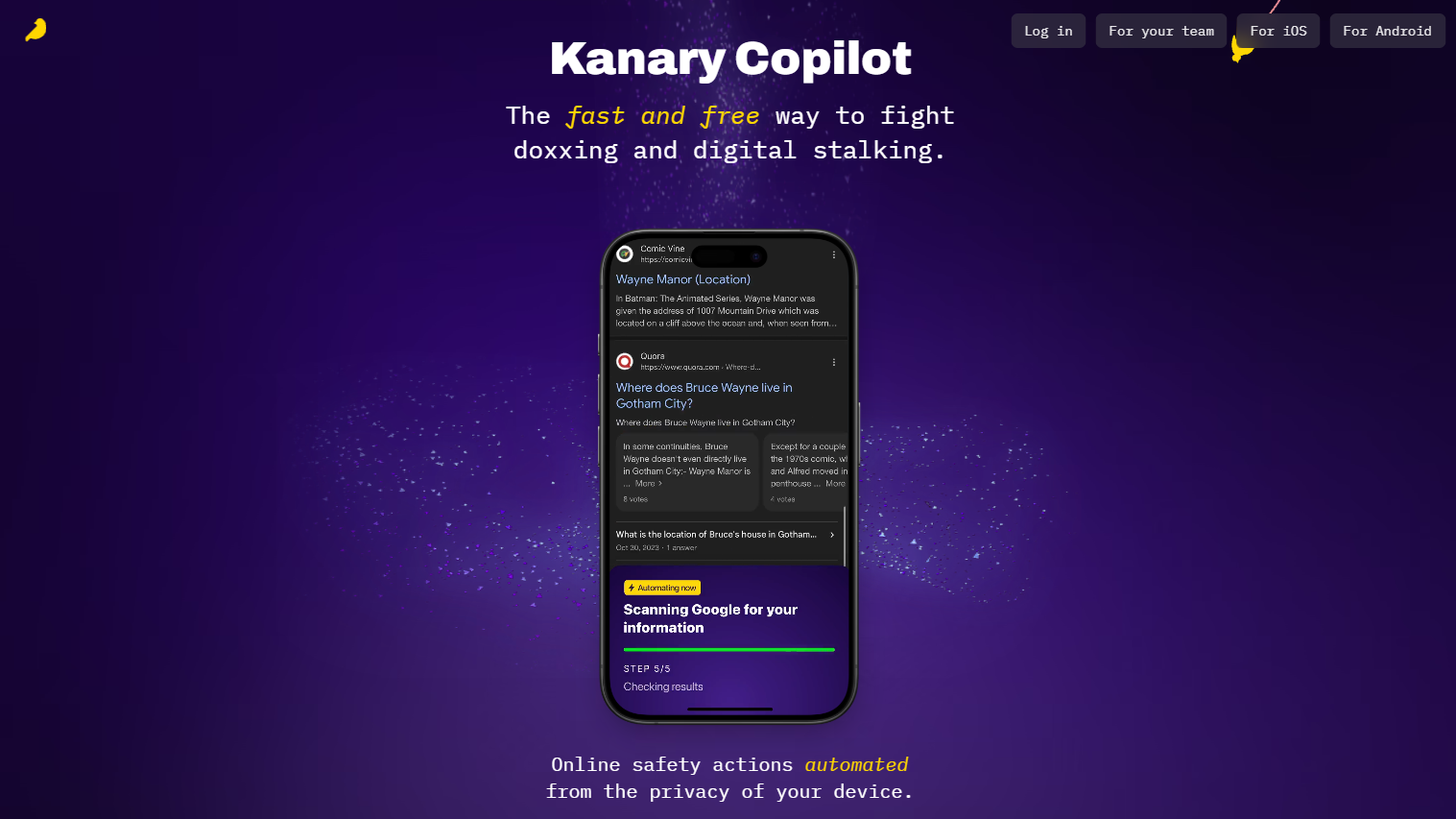
Kanary is designed to get new users up and running quickly, with an onboarding flow that walks you through entering the personal details it needs to search for your data. For individuals, you typically supply your full name, date of birth, and key identifiers such as current and past addresses, phone numbers, and email addresses; this information is then used to match and verify broker listings. Most people can complete the initial setup in just a few minutes, after which the first scan starts automatically, and early results begin to appear within the first couple of weeks.
Enterprise and Teams customers benefit from a streamlined provisioning process: Kanary advertises that business accounts can be fully set up in roughly five minutes using pre‑provisioned accounts or branded access codes for staff. Within about 48 hours, the system begins removing exposed information tied to employees’ professional and personal contact details, which is valuable for organizations worried about doxxing or targeted harassment. As with personal plans, the business dashboards centralize progress across all covered personnel so security teams can see which brokers are responding and where stubborn listings remain.
Kanary’s published removal timeline continues to emphasize staged milestones: an initial two to 14 day scanning window, an estimated 60% removal success around 30 days, roughly 80% between days 31 and 45, and as much as 95–100% removal by the 90‑day mark for typical profiles. These are estimates rather than guarantees, but they provide a useful mental model of how quickly you might expect to see meaningful reductions in your exposed data.
Kanary: Ease of use
Kanary relies heavily on automation to keep the user experience simple after the initial setup. The main dashboard is designed to be readable even for non‑technical users, clearly separating out successful removals, active requests, and items that need your attention, such as brokers that insist on manual opt‑outs or identity verification. Most ongoing work happens in the background: scans and opt‑outs recur automatically monthly, so many users only need to log in occasionally to review progress or respond to a small number of manual tasks.
Because Kanary focuses on US brokers, the interface and guidance tend to be very direct and specific to US privacy norms, which is a plus for American users but a limitation for those living abroad or dealing with non‑US data brokers. Unlike some all‑in‑one security suites, Kanary doesn’t try to overload the interface with unrelated features like antivirus or VPN controls, so the workflow stays focused on tracking and reducing your online footprint. On the downside, if you expect a companion mobile app or extensive real‑time notifications across platforms, Kanary can feel more minimalist than some consumer‑oriented rivals that emphasize mobile‑first design.
Kanary: Security and privacy
Kanary’s appeal rests heavily on how it handles the sensitive information you provide, and in 2026, its security posture is competitive with other serious privacy services. Data is encrypted at rest with AES‑256 and protected in transit via SSL, and backend password handling follows Django standards, using PBKDF2 and SHA‑256 hashing aligned with NIST recommendations. All accounts can be protected with multi‑factor authentication, and enterprise customers get explicit assurances of 256‑bit encryption and MFA as part of the core service design.
Equally important, Kanary states that it does not sell your data to third parties and is explicit about minimizing data collection to what is required to perform searches and removal requests. Its privacy policy and security philosophy resources go into some depth about retention and deletion, giving privacy‑conscious users clearer visibility than many low‑cost competitors. The trade‑off is that Kanary’s focus is squarely on data removal and monitoring, not on financial remediation: it doesn’t bundle identity theft insurance or reimbursement coverage, leaving that gap for other providers or separate identity protection services to fill.
For businesses, Kanary emphasizes a “secure by design” approach, including SOC‑aligned practices, limited data access, and role‑based controls within team dashboards, all aimed at keeping sensitive executive and staff data from becoming another internal risk. Combined with MFA and strong encryption, this makes Kanary an appropriate fit for security‑minded organizations that want to extend privacy protections beyond their technical infrastructure into their employees’ personal online exposure.
Kanary: Support
Kanary offers a mix of self‑service resources and direct support that should be sufficient for most individuals, though it is not the most multi‑channel setup in the market. The website includes an FAQ that walks through how the service works, what types of data it targets, and what you should expect from removal timelines, plus a public list of supported brokers and sites that Kanary monitors and/or removes from. Its blog adds how‑to content for issues like removing your data from Google, tightening up social media privacy, and handling specific brokers, which is useful if you like to understand and occasionally supplement the automated process with manual work.
For direct help, Kanary primarily relies on email support, with enterprise customers also benefiting from more hands‑on, dedicated assistance as part of their managed service. Response quality is generally well‑regarded in third‑party reviews, though you don’t get phone or live chat support as standard, which some users may miss if they are accustomed to real‑time troubleshooting from larger consumer security brands. On balance, the documentation and asynchronous support model match Kanary’s relatively streamlined feature set and will be adequate for most privacy‑focused users who are comfortable managing their account through the web dashboard.
Kanary: The competition
Kanary operates in a crowded data‑removal market where services differ by price, coverage, and features. DeleteMe remains one of the longest‑running options, blending automated and human removals across fewer sites than Kanary’s 300–325 U.S. brokers, starting around $129 per year. Mozilla Monitor Plus is cheaper (about $8.99 per month) and backed by Mozilla’s trusted name, but it offers less automation and coverage, making it suited to casual users.
Optery competes closely with Kanary, offering 300+ brokers and detailed proof of removals at lower entry costs, though its upper tiers can be overkill for most users. Incogni delivers a broad international reach with 420+ brokers and 1,000+ manual sites at mid‑range pricing, but lacks Kanary’s U.S. focus and free tier. Privacy Bee and OneRep provide wider broker lists or family protection, often priced near or above Kanary’s $179.88 annual plan.
For budget users, Mozilla Monitor Plus or entry‑level Optery and OneRep plans may suffice. But privacy‑focused U.S. users seeking extensive broker coverage, a polished interface, and a free option will find Kanary the most balanced choice.
Kanary: Verdict
Kanary remains a solid choice among the best data removal services in 2026, especially for US‑based individuals and families who want a straightforward, set‑and‑forget way to shrink their online footprint. Its combination of 300+ broker coverage, continuous monitoring, and strong security practices (AES‑256 encryption, MFA, and a transparent privacy stance) justifies its higher‑than‑average pricing for many privacy‑conscious users. The ongoing free tier and 14‑day trial help lower the barrier to entry, making it easy to test how much exposed data Kanary can actually remove before committing to a paid plan.
That said, Kanary is not the perfect fit for everyone: it lacks identity theft insurance, focuses primarily on US brokers, and doesn’t always match the sheer global scale or bundled features of some rivals. If your priority is deep US coverage, strong privacy guarantees, and a clean experience that quietly keeps working in the background, Kanary deserves a place on your shortlist alongside DeleteMe, Optery, and Incogni when choosing a data removal service in 2026.




