

Artificial intelligence has significantly simplified the process of SEO optimization for website owners. It has made content creation and discovery easier and more accessible, both individuals and businesses.
MarketMuse is an example of a tool that leverages AI to provide objective insights for planning. A lot has changed with the platform since its 2024 acquisition by SiteImprove. Here's where it currently stands.
- Interested in Marketmuse? Check out the Marketmuse website.
Features
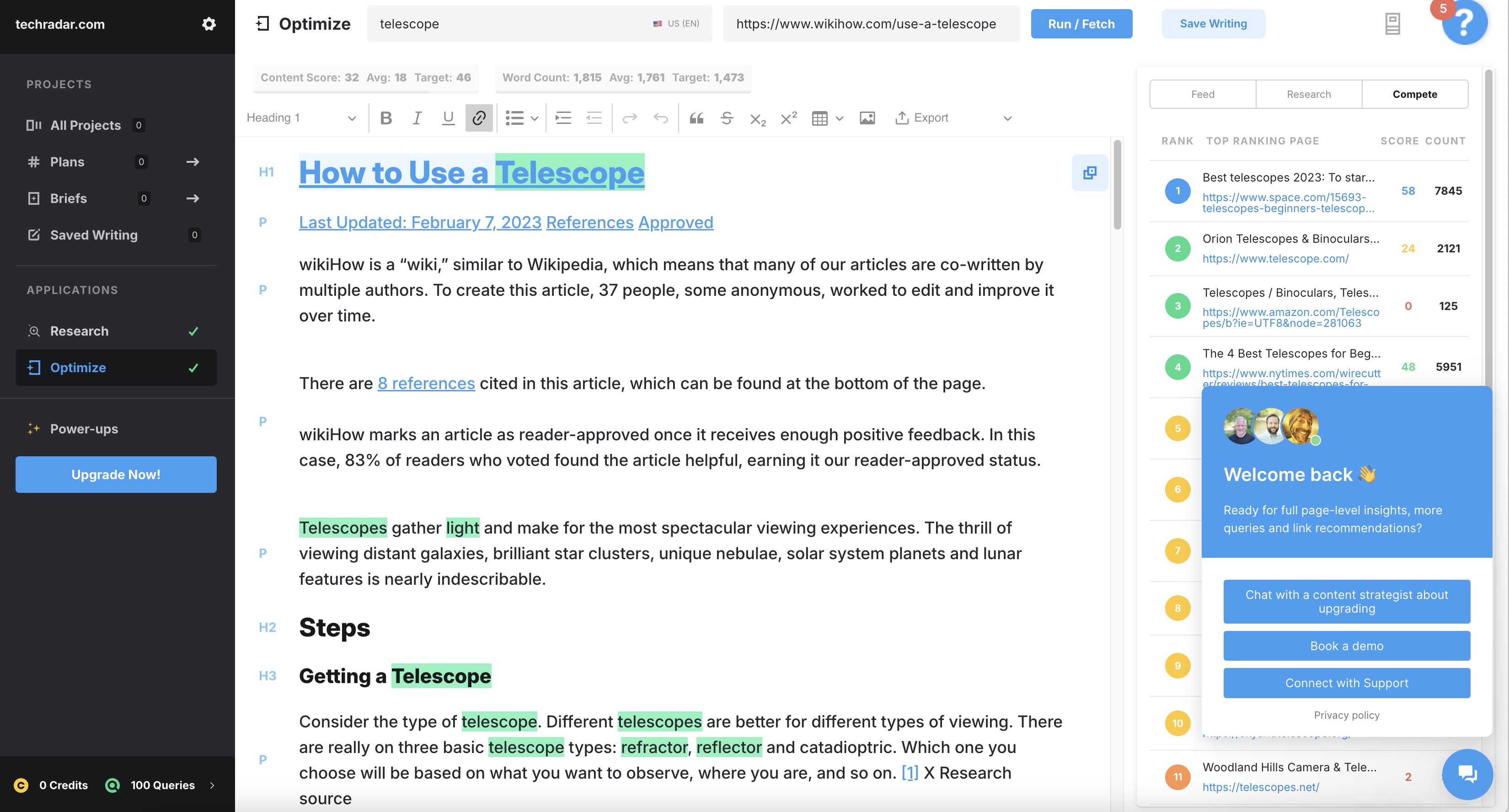
Like tools like Frase, Dashword, Clearscope, and other SEO optimization platforms, MarketMuse supports content creators and marketers in producing top-notch content. This AI-powered tool leverages machine learning algorithms to evaluate content quality, relevance, and depth while enhancing its potential for improved SEO performance.
Utilizing natural language processing capabilities, MarketMuse thoroughly examines a subject. Generates an overview of related topics, keywords, and queries that should be incorporated into the content to enhance its relevance and boost search engine rankings. Doing so offers users an analysis that aids in crafting more thorough and SEO-friendly content. Its seamless integration process also simplifies its incorporation into existing workflows.
As detailed on its website, MarketMuse offerings extend beyond keyword research and content evaluation. This includes access to on-demand inventory technology that enables customers to comprehend the strengths and weaknesses of their online content. Additionally, MarketMuse offers personalized metrics to demonstrate how challenging it may be for a website to rank for keywords. By considering a site's edge in content creation, MarketMuse delivers a precise assessment of the obstacles one might encounter and the opportunities available for leveraging success.
MarketMuse also provides a measure for determining the authority on a topic, emphasizing its importance in recognizing areas where a company thrives and where improvements are needed. This approach helps craft content that establishes an organization as a trusted source in a field.
Moreover, MarketMuse's research capabilities extend beyond keyword analysis. Using its topic modeling technology, MarketMuse sifts through pages to pinpoint essential concepts linked to a specific subject. This thorough investigation aids in identifying content deficiencies,, explore keyword suggestions,, and understand how competitors address these subjects. Furthermore, through the MarketMuse content cluster analysis tool, one can assess the depth and breadth of existing content on a topic. This process assists in spotting any gaps or oversights and guides in developing material or enhancing current pages to ensure comprehensive coverage and enhance the impact of the content.
How does Marketmuse use AI?
Unlike most competitors, MarketMuse has embedded AI into its platform since its founding in 2013. At the core of its approach is proprietary topic modeling technology. For every page and topic you analyze, the platform fetches hundreds to thousands of pages of web content, filters out low-quality outliers, then applies a combination of proprietary and open-source algorithms to classify parts of speech and calculate relevance.
Then there's the AI-automated content inventory feature. Once connected to your domain, MarketMuse's AI crawls your published pages and maps out your existing topical authority — effectively identifying the subjects your site already ranks well for and surfacing gaps where a competitor has the edge. This inventory updates automatically over time, removing the need for manual content audits.
MarketMuse also generates Personalized Difficulty scores, a metric calculated specifically for your site, factoring in your existing topical authority against the competitive landscape for a given query. This means two different sites analyzing the same keyword will receive different difficulty scores, giving content teams genuinely actionable guidance on where to focus effort.
Generative AI also plays a targeted role in the platform. The Optimize application includes a generative AI component that helps users draft content faster. Although, MarketMuse is careful to frame this as a writing accelerator rather than an automated content generator. The real AI firepower sits in planning and prioritization: automated cluster analysis, AI-generated content briefs that lay out required topics, subtopics, and questions, and competitive gap analysis that identifies what top-ranking pages cover that yours does not.
Following its acquisition by Siteimprove in October 2024, MarketMuse's AI capabilities are now available as part of a broader platform that integrates accessibility, SEO, analytics, and cross-channel advertising — a meaningful step toward a unified content marketing workflow.
Installation, setup, and compatibility
MarketMuse is entirely browser-based, meaning you simply visit the platform through any modern web browser and create an account using your name, email, and a password. After signup, you'll receive a confirmation email, and once verified you're taken directly to the dashboard.
The onboarding process also prompts you to connect your site's domain, which kicks off the automated content inventory process that underpins much of the platform's intelligence. Depending on the size of your site, this initial crawl can take a little time, but most users report being ready to run their first analyses within minutes.
The dashboard itself is organized around a set of core applications — Optimize, Research, Compete, Questions, and Connect. Each tab is designed to handle a distinct phase of the content workflow. New users will likely find the Inventory feature the natural starting point. From there, you can move into Topic Research to investigate search intent, identify related subtopics, and build out content plans without switching tools. Everything is cleanly laid out, but the sheer number of metrics and applications means there is a genuine learning curve before the platform starts to feel intuitive.
For teams looking to accelerate that process, MarketMuse offers the MarketMuse Academy, a learning hub with blog posts, video walkthroughs, and webinar-based content strategy courses. Higher-tier plan holders also have access to more direct support, including onboarding calls and team training. It's worth noting that paid plan features like data export, content briefs, and domain analysis become relevant quickly once you're past initial exploration, so users on the free tier will bump into limitations fairly soon.
Plans and pricing
|
Plan |
Starting Rate (paid annually) |
Starting Rate (paid monthly) |
|---|---|---|
|
Free |
$0/month |
$0/month |
|
Optimize |
$83.25/month ($999/year) |
$99/month |
|
Research |
$208.25/month ($2,499/year) |
$249/month |
|
Strategy |
$458.25/month ($5,499/year) |
$499/month |
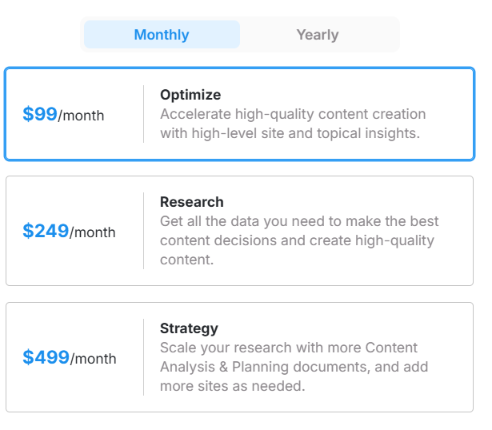
MarketMuse currently offers four plans — Free, Optimize, Research, and Strategy. It's a restructured lineup that replaced the older Standard, Team, and Premium tiers. The Free plan gives a single user 10 queries per month with no credit card required, making it a low-risk way to explore the platform before committing. Paid plans are available on both monthly and annual billing, with annual subscriptions offering meaningful savings across all tiers.
The entry-level Optimize plan starts at $99 per month (or $999 per year), giving individual users and small teams access to high-level site and topical insights to accelerate content creation. The mid-tier Research plan, at $249 per month (or $2,499 per year), is geared toward mid-sized teams that need comprehensive data for content decisions and high-quality content production.
Agencies and larger organizations scaling across multiple sites will want to consider the Strategy plan at $499 per month (or $5,499 per year), which adds more Content Analysis and Planning documents along with multi-site support. Enterprise users who need a fully customized arrangement can contact MarketMuse directly.
Final verdict
One of the best things about MarketMuse is that it’s been designed to help individuals and small and large teams. This isn’t always the case with similar products that target individuals or large organizations, but not both. From a product standpoint, there’s much to love about MarketMuse. The AI-based guidance provided by MarketMuse ensures you create in-depth, high-quality content related to your chosen topic. It helps in developing the most comprehensive and authoritative content possible. By increasing the relevance and depth of the content, MarketMuse can dramatically boost the SEO success rate. A well-optimized, high-quality content can naturally rank higher on search engine results pages.
Additionally, with MarketMuse's ability to recognize related content, users can create a robust, interlinked content strategy. These linked clusters of content can significantly improve your website's domain authority.
There are a few things to criticize about MarketMuse, however. First, although I have no doubt users of all backgrounds can get started with MarketMuse with relative ease, there’s a huge learning curve to master the platform’s full range of platforms. For this, I’d strongly suggest looking into paid training through MarketMuse.
It’s important to note that SEO optimization tools like MarketMuse have another significant drawback. They have no control over the dynamic nature of search engine algorithms. This means that even the best tools will be affected if Google changes how it handles searches. As a result, companies like MarketMuse must adjust the data behind their offerings, and end-users will also need to make necessary adjustments. This can be a challenging process for everyone involved.
More from TechRadar Pro
- See our best on-page SEO tool of the year
- We've also featured the best AI tools.




