

Aircall provides a cloud-based VoIP phone system designed for sales, support, and customer management teams across small businesses to enterprises.
It emphasizes simplicity, integrations with over 100 tools, and features such as call routing and AI enhancements to support efficient communication.
This updated 2026 review covers its plans, features, usability, security, support, competitors, and overall value.
Aircall VoIP: Plans and pricing
Aircall structures pricing around three tiers—Essentials, Professional, and Custom—billed per license with a three-user minimum for the first two and 25 for Custom; annual plans start at $30/user/month for Essentials, $50 for Professional, and custom quotes for enterprises.
Essentials includes unlimited US/Canada calls, one number, basic IVR, call recording (up to 1 year), and 6 months of basic analytics, while Professional adds a power dialer, advanced analytics, voicemail drop, and deeper CRM integrations, such as Salesforce.
Custom offers unlimited analytics, SLAs, expanded international calling, and personalized onboarding. Add-ons such as AI summaries ($9/user/month) or Analytics+ ($15/user/month) apply across plans, and promotions include two free months with annual billing through January 2026.
Aircall VoIP: Features
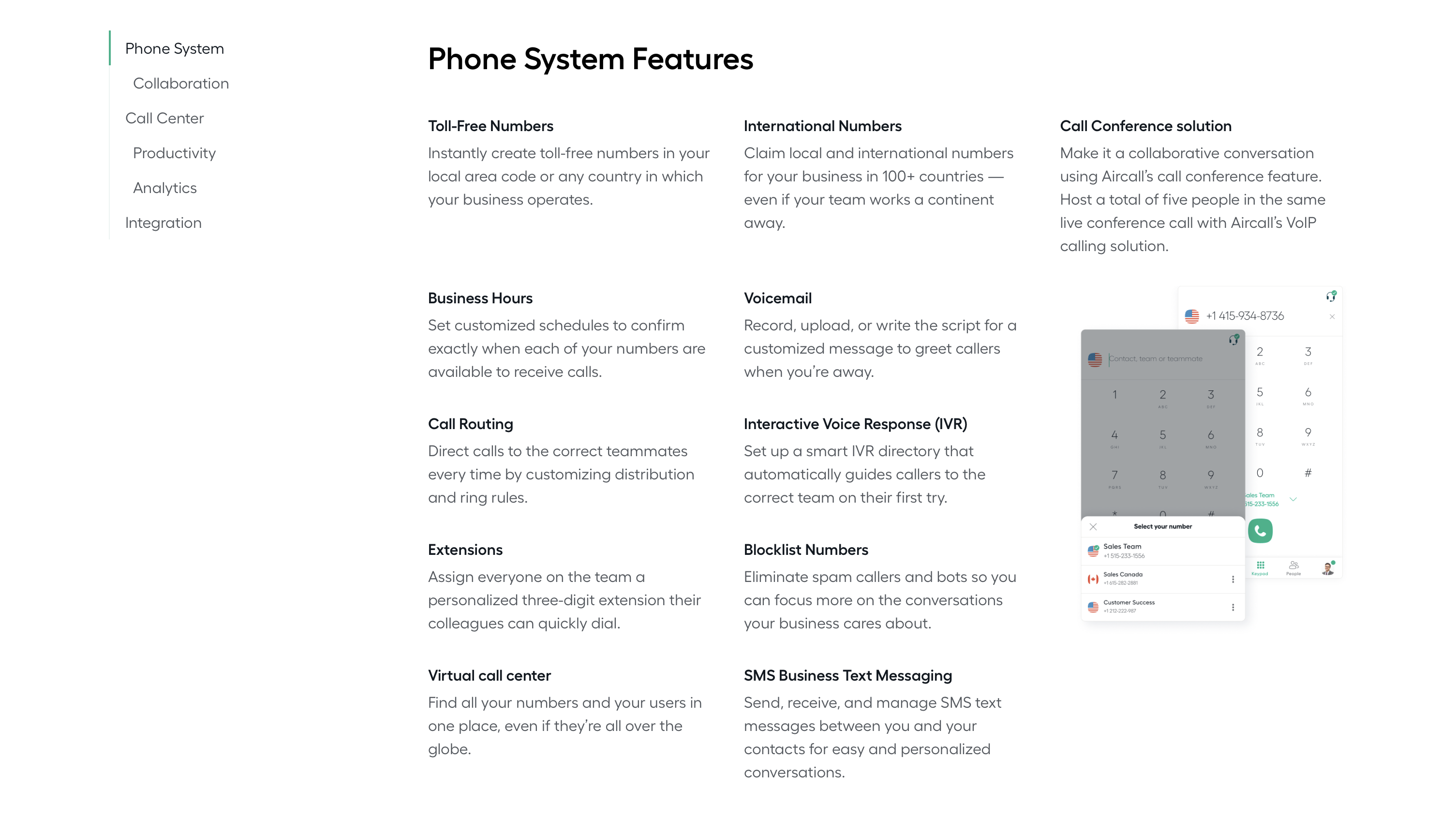
Aircall supports desktop and mobile app calls with unlimited concurrent calls, IVR, call queuing, ring groups, and real-time routing based on time or skills.
Key tools include a power dialer, call recording with pause-and-resume, AI transcription and summaries, SMS/MMS, click-to-dial, after-call work, tags, and over 100 CRM integrations with HubSpot, Slack, and Pipedrive.
Conferencing limits to five participants without video, but analytics track volume, wait times, and performance; international calls and extra SMS incur fees beyond domestic bundles.
Aircall VoIP: Set up
Initial setup involves downloading the app, logging in, and configuring numbers, IVR, Teams, and integrations via the dashboard, often taking minutes and requiring minimal IT support.
Users port numbers or purchase new local/toll-free ones, set preferences, and sync contacts from Google or CRMs; mobile apps for iOS/Android enable on-the-go management.
A free trial allows testing before commitment, with guides for quick onboarding.
Aircall VoIP: Ease of use
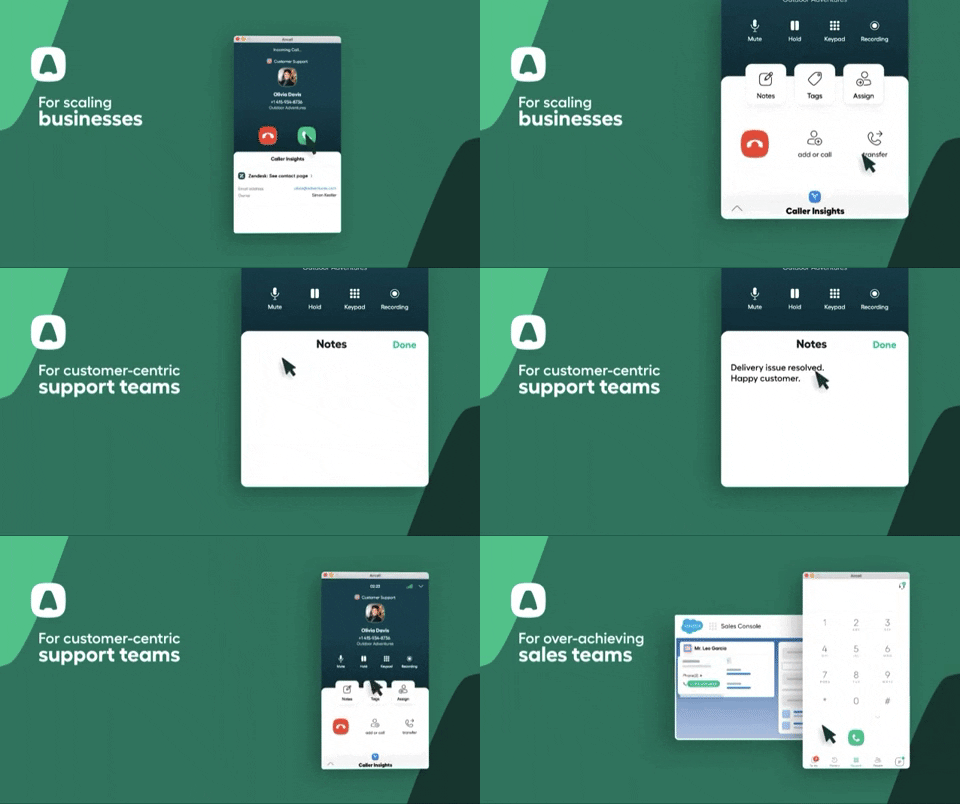
The minimalist dashboard centralizes dialer, contacts, search, calls, and analytics, praised for its intuitiveness and minimal training needs.
Mobile and desktop interfaces reduce clutter, with features such as desktop notifications and speaker ringing that enhance accessibility for remote or hybrid teams.
Users report quick adaptation, straightforward call handling, and efficient workflows.
Aircall VoIP: Support

All tiers have access to a knowledge base, onboarding guides, live chat, chatbot, email, and phone (e.g., US: 888-240-6923). English support runs 24/5; French support runs 9 AM-6 PM CET.
Professional and Custom get dedicated managers and SLAs; website contact form aids quick resolutions.
Aircall VoIP: Security
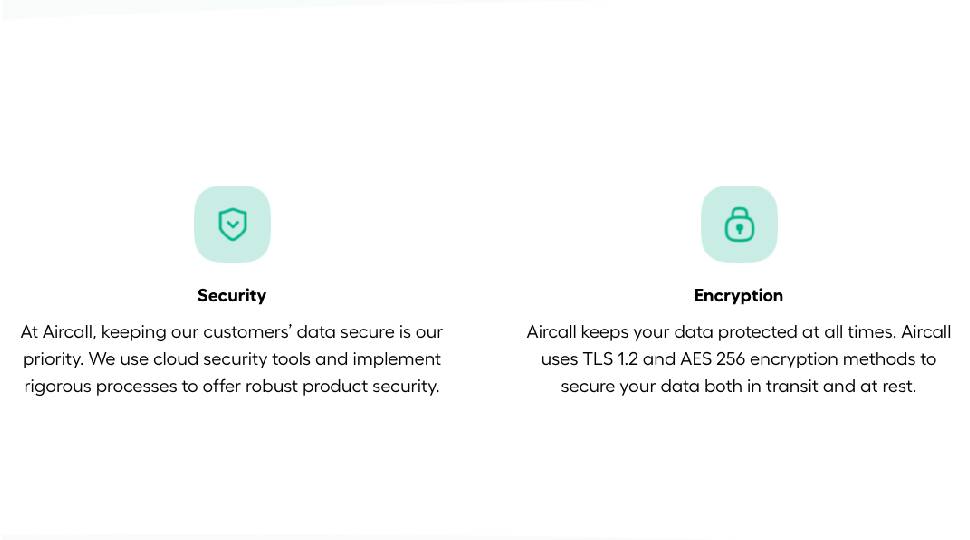
Aircall secures all calls and data with strong encryption and AWS cloud protection. It’s SOC 2 Type 2 compliant and supports 2FA, SSO, role-based access, and spam blocking. Regular security tests, GDPR compliance, and multi-zone backups help guard against threats such as eavesdropping, DDoS, and vishing.
Data protection
Aircall also operates a vendor management program that is designed to protect sensitive information and complies with all relevant laws. The VoIP provider evaluates all new vendors to ensure they meet internal security and privacy standards.
Integration security
For many VoIP services, having a large number of integrations with third-party services is essential. For Aircall, this means having partnerships with big-name CRM players like Salesforce and HubSpot, as well as integrations with smaller players like transcription platform Jiminny and recruitment service Bullhorn.
While the larger players are likely to already be adhering to the highest security standards, smaller third-party services are more of an unknown quantity. That’s why it’s reassuring that Aircall vets all its integrations before approval.
Given that the number of cyberattacks targeting VoIP platforms have risen significantly recently as more companies resort to Internet-based communications following the boom of the hybrid working routine, Aircall’s security standards should provide businesses with a little more peace of mind.
Furthermore, Aircall regularly performs penetration testing and operates a generous bug bounty program to ensure that any vulnerabilities that are present are discovered and patched before the bad actors become aware of them.
Security expertise
In addition, Aircall runs a blog examining certain issues related to VoIP technology - including existing security issues. The company walks through some of the main attack vectors, including vishing, DDoS attacks, eavesdropping and phreaking.
As well as cyberattacks, VoIP users will also be keen to ensure that they select a reliable VoIP service. Again, Aircall scores highly here, regularly backing up customer data and using AWS as a hosting provider to ensure a resilient service.
Aircall VoIP: The competition
Aircall competes with RingCentral, which starts at around $20/user/month and includes video support plus robust enterprise features; Nextiva, at $ 15+/user, offers a unified customer experience and high reliability.
Dialpad provides AI coaching from $15/user, while CloudTalk at $25/user adds custom reporting and more CRMs; options like Ooma or Phone.com suit tighter budgets but lack Aircall's extensiveness.
Aircall stands out for customizability and integrations in sales/support scenarios.
Aircall VoIP: Final verdict
Aircall suits SMBs and teams needing flexible, integrated VoIP with strong analytics and ease of use, despite higher pricing and add-on costs.
Its security, support, and call tools impress for customer-facing operations.




